There’s a quiet war happening in gardens across Ireland. On one side, we have the Pristine Perfectionists—the champions of immaculate lawns, stone patios, and artificial grass that could survive a nuclear winter. On the other side, we have the Rewilding Revolutionaries—the ones letting their gardens go feral, complete with brambles, bees, and a few stinging nettles for good measure.
And smack in the middle? Us landscapers, trying to please everyone while quietly muttering into our wheelbarrows.
I’m Scott D. Renwick, co-founder of SAS Landscapes Ltd., and we’ve seen it all. We’ve built polished patios so clean you could eat your dinner off them (though I wouldn’t recommend it), and we’ve created rewilded havens where butterflies outnumber humans. Both approaches have their merits. Both have their drawbacks. And, to be honest, both sides could do with a reality check.
The Pristine Perfectionists
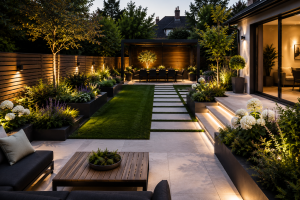
Let’s start with the lovers of hard surfaces and artificial turf. You know the type. They want straight lines, symmetry, and a garden that could be mistaken for a showroom. No weeds, no dirt, and definitely no wildlife that might make a mess.
Their argument? Practicality. Low maintenance. Clean lines that look good in every season.
And listen, I get it. Not everyone has the time or energy to be out there every weekend deadheading roses or weeding the borders. A neat, easy-to-manage space is appealing, especially in a world where life already feels chaotic.
But here’s the thing: nature isn’t meant to be sterile. Covering every inch of your garden with artificial grass and porcelain paving might look great on Instagram, but it’s an ecological dead zone. That perfectly manicured, lifeless space isn’t just bad for bees—it’s bad for the soul. Gardens are supposed to breathe. They’re supposed to grow and change and surprise you.
And don’t even get me started on artificial grass. Sure, it’s green all year round, but it heats up like a frying pan in summer, releases microplastics into the soil, and will eventually end up in a landfill. So while you might not have to mow it, you’re definitely not winning any prizes for sustainability.
The Rewilding Revolutionaries
Now, on the other end of the spectrum, we have the rewilders. These are the people who’ve taken the phrase “let it grow” to heart. Their gardens are bursting with wildflowers, buzzing with insects, and occasionally home to a fox or two.
Their argument? Nature knows best. Biodiversity is king.
And honestly, I love this approach—when it’s done right. A rewilded garden can be a magical place, full of life and movement. It’s good for the planet, good for local wildlife, and good for your mental health. There’s something deeply satisfying about watching a butterfly land on a flower you planted (or that planted itself, if we’re being honest).
Ireland’s own Mary Reynolds, a globally renowned garden designer, has been leading the charge in this movement. Her philosophy centers on rewilding as a way of healing not just our gardens but also ourselves. She’s inspired a new generation to step away from the lawnmower and let nature reclaim its rightful space.
But—and here’s the big “but”—rewilding isn’t as effortless as it sounds. Letting your garden grow wild doesn’t mean abandoning it entirely. It takes knowledge and care to create a space that’s both functional and ecologically sound. A pile of weeds isn’t rewilding; it’s just neglect.
And here’s where the idealism sometimes clashes with reality. A fully rewilded garden can be difficult to navigate, tricky to control, and occasionally home to some unwelcome visitors (wasps, anyone?). It’s not for everyone, and that’s okay.
Who’s Right?
So, who wins this battle of the backyards? The truth is, neither side is entirely right—or entirely wrong.
The Pristine Perfectionists are right to want a space that’s easy to enjoy and fits their lifestyle. Not everyone wants to spend their free time maintaining a wildflower meadow, and that’s perfectly valid. But they also need to understand the environmental cost of their choices. A lifeless garden isn’t just a missed opportunity for biodiversity—it’s a step in the wrong direction for the planet.
The Rewilding Revolutionaries, meanwhile, have their hearts in the right place. They’re fighting for a better future, one garden at a time. But they also need to recognize that not everyone can—or wants to—embrace the messiness of nature. Balance is key, and sometimes a little compromise is necessary.
The Ethical Middle Ground
Here’s what I suggest: meet in the middle.
You don’t have to choose between a concrete jungle and a wild forest. It’s possible to have a garden that’s both beautiful and biodiverse. Incorporate native plants alongside your favorite flowers. Create a small wildflower patch instead of rewilding the entire lawn. Use natural stone for your patio but leave room for soft landscaping around it.
And speaking of natural stone, some of our favorite projects at SAS Landscapes have found this perfect balance. Whether it’s an elegant sandstone patio in Blackrock or a meandering stone path lined with lush planting in Foxrock, we’ve seen how natural materials can harmonize with the environment while giving clients a durable, timeless finish. (Check out more of our feature projects on saslandscapes.ie for some inspiration!)
What Does Your Garden Say About You?
At the end of the day, your garden reflects your values. Do you prioritize convenience over ecology? Do you see your outdoor space as an extension of nature or a buffer against it?
Neither approach is inherently wrong, but both require thought and care. So before you order that pallet of porcelain paving slabs or decide to let the brambles take over, ask yourself: what kind of garden do I want to leave behind?
Because whether you’re a Pristine Perfectionist, a Rewilding Revolutionary, or (like most of us) somewhere in between, your garden is more than just a patch of land. It’s part of a bigger picture—and we all have a role to play in making that picture as vibrant and sustainable as possible.
Scott D. Renwick is the co-founder of SAS Landscapes Ltd., a landscape construction and maintenance company in Dublin, Ireland. When he’s not transforming gardens, he’s stirring up debates about how to make them better for people and the planet.