
First impressions matter.
Whether you’re planning to sell your home or simply want to enjoy coming home every day, good curb appeal makes a huge difference. A well-designed front garden doesn’t just look attractive—it creates a sense of quality, balance and care before anyone even reaches the front door.
Professional landscape designers don’t rely on expensive materials alone. Instead, they combine layout, proportion, planting and construction to create a welcoming entrance that complements the property.
Here’s how they do it.
Start with the House, Not the Garden
One of the biggest mistakes homeowners make is treating the front garden as a separate project.
A good landscape designer starts with the house itself.
The style, age, materials and proportions of the property should all influence the design. A contemporary home often suits clean lines, large paving slabs and architectural planting, while a traditional home may benefit from natural stone, softer planting and curved pathways.
The aim is for the garden and house to feel like they were designed together.
Create a Clear Entrance
Visitors should immediately know where to go.
A well-defined path naturally guides people to the front door and creates structure within the garden.
Professional designers consider:
- Path width
- Alignment with the entrance
- Choice of paving materials
- Step design
- Accessibility
- Drainage
Even a simple path can dramatically improve the appearance of a property when it is properly designed and constructed.
Choose the Right Paving
Paving often becomes the dominant feature of a front garden.
Choosing the right material is about far more than appearance.
Landscape designers consider:
- Scale of the paving
- Colour compatibility with the house
- Slip resistance
- Durability
- Drainage performance
- Long-term maintenance
Poorly installed paving can quickly develop movement, staining or drainage problems, which is why correct installation is just as important as selecting attractive materials.
Keep Planting Simple
Many front gardens suffer from having too many different plants.
Professional designers often achieve better results by using fewer plant varieties repeated throughout the design.
This creates:
- Better structure
- Cleaner appearance
- Easier maintenance
- Greater visual impact
Evergreen shrubs provide year-round interest, while carefully chosen seasonal plants add colour without making the garden feel cluttered.
Use Different Heights
Flat gardens often feel lifeless.
Introducing different heights creates depth and visual interest.
This can be achieved through:
- Raised planting beds
- Low retaining walls
- Multi-stem trees
- Feature shrubs
- Decorative planters
Vertical elements help frame the entrance and naturally draw attention towards the property.
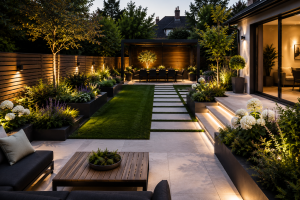
Think About Lighting
A beautiful front garden shouldn’t disappear after sunset.
Subtle outdoor lighting can transform the appearance of a property while also improving safety.
Popular options include:
- Path lighting
- Step lighting
- Wall lights
- Uplighting for specimen trees
- Feature lighting around planting
The goal is to create atmosphere rather than brightness.
Reduce Visual Clutter
Good design is often about removing unnecessary elements.
Professional landscape designers carefully consider where to hide:
- Wheelie bins
- Utility boxes
- Drain covers
- Pipework
- Storage areas
Reducing clutter allows the eye to focus on the attractive parts of the garden instead.
Pay Attention to Small Details
The difference between an average front garden and an exceptional one is often found in the details.
For example:
- Perfectly straight edging.
- Consistent paving joints.
- Flush inspection covers.
- Well-finished steps.
- Smooth transitions between materials.
- Neatly defined planting beds.
These details may go unnoticed individually, but together they create a feeling of quality.
Design for Low Maintenance
A beautiful garden should remain attractive without requiring constant work.
Professional designers often recommend:
- Quality weed-suppressing bark mulch.
- Evergreen planting.
- Durable paving materials.
- Efficient drainage.
- Clearly defined planting areas.
Reducing maintenance encourages homeowners to keep the garden looking its best for years to come.
Think Long-Term
Good curb appeal isn’t created on the day the project is finished.
Landscape designers think about how the garden will look in five, ten and even twenty years.
Trees mature.
Plants grow.
Materials weather.
A successful design allows for these natural changes while continuing to look balanced over time.
Why Professional Design Matters
Creating curb appeal is about much more than laying new paving or planting colourful flowers.
Professional landscape designers combine design, construction knowledge and practical experience to create outdoor spaces that are attractive, functional and built to last.
The result is a front garden that not only looks impressive today but continues to enhance your home for many years to come.
Looking to Improve Your Front Garden?
At SAS Landscapes, we design and build front gardens that combine high-quality craftsmanship with practical, long-lasting design. Whether you’re looking to improve your home’s appearance, increase property value or simply create a welcoming entrance, we’re happy to help.
Contact SAS Landscapes today to arrange a consultation.