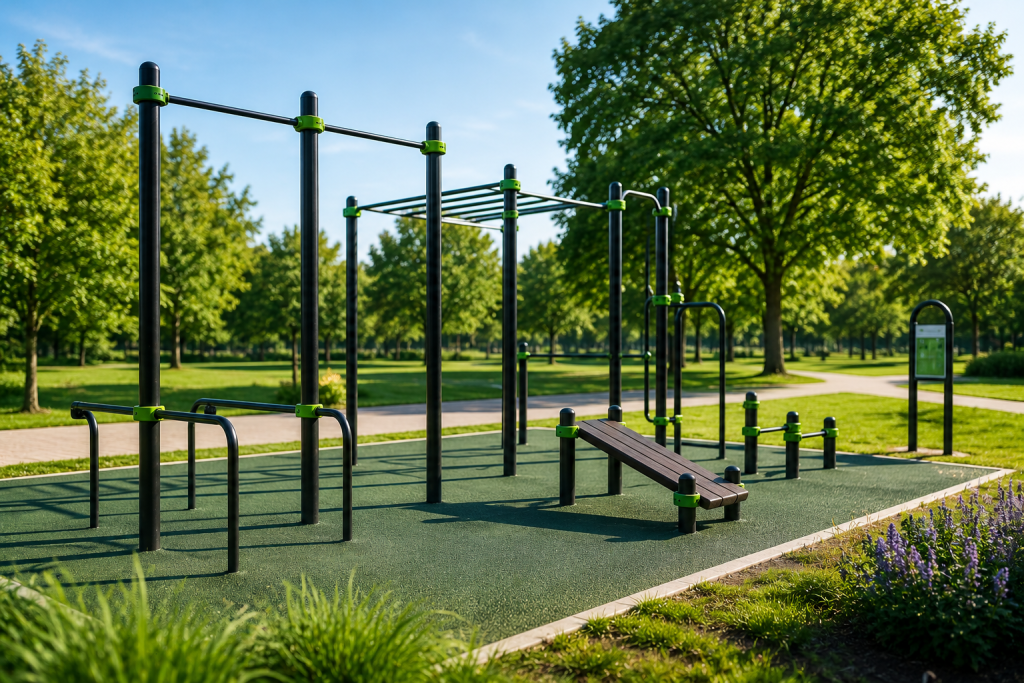
Outdoor calisthenics parks are becoming increasingly popular across Ireland.
They provide free access to strength training, improve public health and create spaces where people of all ages can exercise together.
If your local park doesn’t have calisthenics equipment, you don’t have to wait for someone else to suggest it.
Many successful outdoor gyms begin with a single resident asking the right questions.
In this guide, we’ll explain how to approach your local authority, build support within your community and give your proposal the best chance of success.
Start by Identifying the Right Landowner
Before making a request, establish who owns or manages the park.
This could be:
- Your local county council.
- A city council.
- A town council.
- A management company.
- A community organisation.
- A school or sports club.
Most public parks in Ireland are managed by the local authority.
Once you know who is responsible, you can direct your proposal to the appropriate department.
Explain the Community Benefit
Councils are more likely to support projects that benefit the wider community rather than a small group of individuals.
Explain how outdoor fitness equipment can:
- Improve public health.
- Encourage physical activity.
- Create opportunities for all age groups.
- Support teenagers and young adults.
- Promote social interaction.
- Provide free access to exercise.
Focus on the long-term value the equipment will bring rather than simply asking for new facilities.
Show That People Will Use It
One of the strongest ways to support your proposal is to demonstrate local demand.
You could:
- Gather signatures from residents.
- Create an online petition.
- Ask local sports clubs for support.
- Speak with schools.
- Involve community groups.
- Share the idea on local social media pages.
If the council can clearly see community interest, the proposal becomes much stronger.
Suggest a Suitable Location
Rather than simply asking for equipment, identify where it could realistically be installed.
Look for areas that are:
- Easily accessible.
- Visible and well-used.
- Large enough to allow safe movement.
- Close to existing pathways.
- Away from heavy traffic.
You don’t need to design the layout yourself, but demonstrating that you’ve thought about the practicalities will strengthen your proposal.
Think Beyond Pull-Up Bars
Modern calisthenics parks can accommodate people of all abilities.
Depending on the available space and budget, equipment may include:
- Pull-up bars.
- Parallel bars.
- Monkey bars.
- Dip stations.
- Push-up bars.
- Balance equipment.
- Incline benches.
- Swedish ladders.
A well-designed outdoor gym encourages complete bodyweight workouts rather than focusing on one exercise.
Be Patient
Public projects rarely happen quickly.
Your proposal may need to:
- Be reviewed internally.
- Be included in future budgets.
- Receive funding approval.
- Form part of wider park improvements.
Following up politely every few months often produces better results than repeatedly demanding immediate action.
Persistence matters.
Work With Local Representatives
Your local councillors are there to represent the community.
If they understand the benefits and know residents support the proposal, they may be willing to raise the issue with the council on your behalf.
Building relationships with local representatives can significantly improve the chances of your project being considered.
Work With Experienced Professionals
Choosing the right equipment is only part of the process. A successful outdoor gym should be designed around how people actually train, ensuring the layout is intuitive, safe and suitable for users of different abilities.
At SAS Landscapes, we work alongside Trainer to help create outdoor fitness spaces that are both practical and enjoyable to use. By combining landscape construction with fitness expertise, we can deliver installations that encourage long-term community use rather than simply installing a collection of bars.
Whether you’re planning a community park, school, residential development or private training area, professional design will always produce a better result.
Professional Design Matters
Installing outdoor fitness equipment isn’t simply about placing a few bars in a park.
A successful calisthenics facility should consider:
- Safety.
- Accessibility.
- Ground surfaces.
- Drainage.
- User flow.
- Future maintenance.
- Compliance with relevant safety standards.
Good planning helps ensure the equipment remains safe, durable and enjoyable for years to come.
If you’re considering a private installation instead, read our guide Can I Install a Calisthenics Gym in My Backyard?
Frequently Asked Questions
Can anyone request calisthenics equipment in a public park?
Yes. Any resident can contact their local authority and suggest improvements to public spaces.
Does the council have to install it?
No. The final decision depends on funding, available space, priorities and community support.
Will community support improve the chances?
Absolutely. Demonstrating that many local residents want the facility is one of the strongest arguments you can make.
Can local businesses help?
In some cases, yes. Sponsorship or partnerships may help support community projects, although this depends on the local authority’s policies.
Conclusion
Outdoor calisthenics parks are one of the most accessible ways to encourage healthier communities.
While funding decisions ultimately rest with the local authority, well-prepared proposals supported by local residents often receive far more consideration than simple requests.
If your community would benefit from an outdoor fitness space, don’t assume someone else will ask.
Your proposal could be the first step towards creating a facility that benefits generations to come.
If you’re interested in installing outdoor fitness equipment on your own property, explore our Outdoor Calisthenics Equipment service to learn how we design and install bespoke training spaces for homes, schools and commercial developments.